
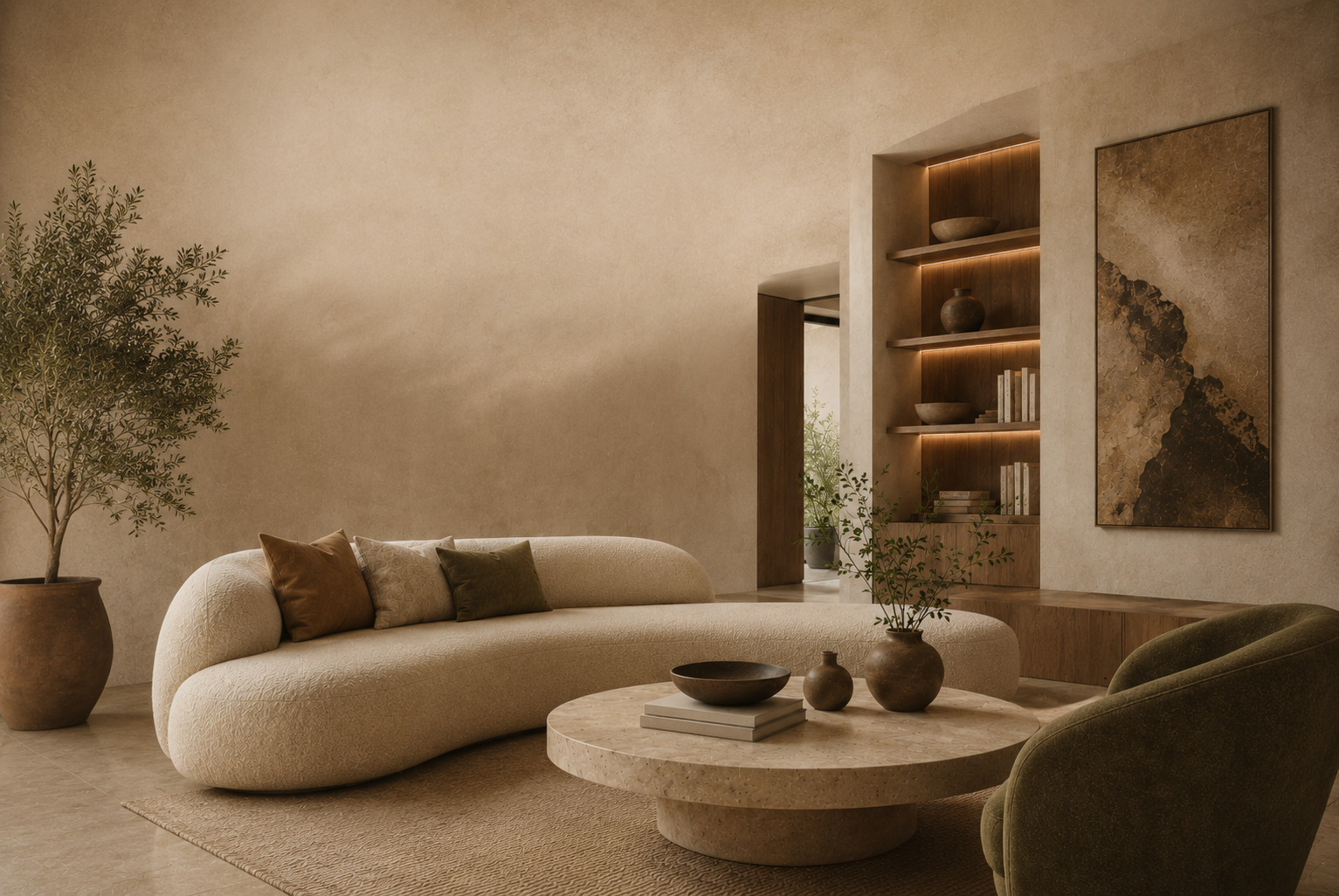
In a culture that equates fullness with success, restraint has become the rarest luxury. Empty space is not absence - it is intention, breath and the quiet frame that lets a home, an object and a life finally be seen.
The most expensive thing in a modern home is no longer the marble, the joinery, or the chandelier. It is the empty space between them.
We have inherited a century of accumulation. Rooms are asked to perform - to entertain, to impress, to prove. Every surface earns its keep; every wall carries an argument. And yet, in the houses that endure, the ones that photograph poorly and live magnificently, something else is at work. There is a discipline of subtraction, a willingness to let a wall be a wall.
Restraint as the rarest luxury
In a culture that equates fullness with success, restraint has become quietly radical. To leave a corner unstyled, a table unadorned, a ceiling untouched - these are not omissions. They are decisions. They cost something: the courage to trust proportion over ornament, and the client and the atelier to trust one another.
Empty space is not absence. It is the frame that lets everything else finally be seen.
The Japanese call it ma - the pause between two notes that makes the melody. Architects talk about poché, the thickness of a wall. Landscape designers speak of the clearing. Different words, one instinct: that meaning lives in the interval, not only in the object.
How a room breathes
A well-made room breathes the way a well-made sentence does. There are load-bearing words and there are the small, unglamorous ones that let the sentence stand. Remove the connective tissue and the meaning collapses; overload it and no one reads to the end.
The same is true of interiors. A generous void beside a considered piece of furniture doubles its authority. A quiet threshold makes the next room arrive as a discovery. A ceiling left plain becomes a horizon. These are not empty gestures - they are the frame the eye needs in order to rest.
The economics of quiet
Restraint is not cheap. It requires better proportions, better materials, and better craftsmanship, because there is nowhere for a mistake to hide. A plastered wall with nothing on it must be a truly good plastered wall. A single stone bench in a courtyard has to earn its solitude.
This is the paradox our clients understand: the fewer the elements, the higher the standard each one must meet. Empty space is expensive precisely because it refuses to compensate.
Designing for the life you actually live
A home that is 20 per cent less full is often 40 per cent more livable. There is room to move a chair, to open a book on the floor, to host without rearranging, to let a child build something, to let a season change the light on an unbroken wall. The house stops performing and starts hosting.
That, in the end, is the case for empty space. Not minimalism as a style, but restraint as a form of respect - for the architecture, for the objects that do remain, and for the people who will live inside it long after the atelier has left the site.